
Nothing disrupts a trip faster than arriving at your destination only to realize your suitcase never made it to the baggage carousel. Whether you’re traveling for business, a family vacation, or an important event, missing luggage can be stressful. Fortunately, understanding the correct steps can significantly improve your chances of recovering your belongings quickly.
This comprehensive guide explains everything you need to know about Alaska Airline lost baggage, including how to report missing luggage, track your claim, understand compensation policies, protect your belongings, and avoid common mistakes. You’ll also learn practical travel tips and expert advice to help you navigate the process with confidence.
What You’ll Learn
- What qualifies as lost, delayed, or damaged baggage
- How the baggage tracing process works
- Steps to report missing luggage
- Documents you’ll need for a successful claim
- How baggage tracking systems operate
- Passenger compensation and reimbursement options
- Domestic and international baggage rules
- Common mistakes travelers should avoid
- Tips to reduce the risk of lost luggage on future trips
Understanding Alaska Airlines Lost Baggage
Lost baggage refers to checked luggage that cannot be located after a reasonable search period. In many situations, luggage is initially classified as delayed rather than permanently lost because airlines often locate and deliver missing bags within a few days.
Understanding the difference helps set realistic expectations.
| Situation | Meaning |
|---|---|
| Delayed baggage | Luggage arrives later than the passenger |
| Lost baggage | The airline cannot locate the bag after extensive searching |
| Damaged baggage | The suitcase or its contents arrive damaged |
| Missing contents | Some belongings are missing while the suitcase is returned |
Industry data published by aviation organizations indicates that millions of checked bags travel successfully each year, while only a small percentage experience delays or mishandling. Most delayed bags are reunited with passengers within the first 48 hours, especially on domestic routes.
Why Checked Bags Sometimes Go Missing
Although airline baggage systems are highly automated, luggage can occasionally be separated from passengers due to operational challenges.
Some of the most common reasons include:
- Tight flight connections
- Incorrect baggage tag scanning
- Flight disruptions caused by weather
- Last-minute aircraft changes
- Security inspections
- Human handling errors
- Conveyor belt malfunctions
- Misrouted transfer baggage
- Similar-looking luggage picked up by another traveler
For connecting flights, baggage typically transfers automatically between aircraft. However, short layovers increase the possibility that luggage may arrive on a later flight.
Travel experts recommend allowing additional connection time whenever possible, especially during busy travel seasons.
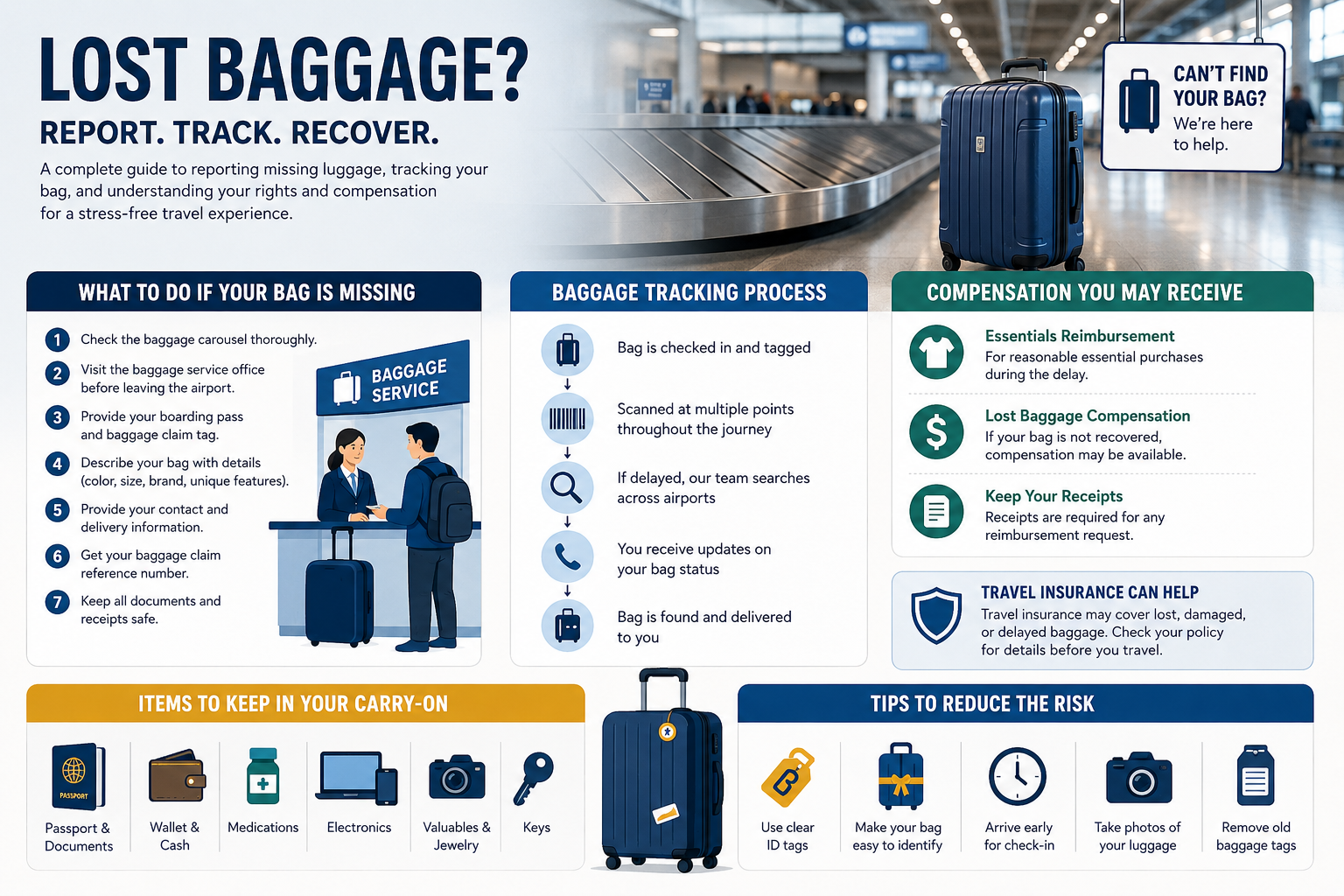
What To Do Immediately If Your Luggage Is Missing
The first hour after discovering missing baggage is the most important. Acting quickly helps airline representatives begin tracing your suitcase while information is still fresh.
Follow these steps before leaving the airport:
- Confirm your luggage is not still arriving on the baggage carousel.
- Verify that you’re standing at the correct baggage claim area.
- Check oversized baggage collection locations.
- Review nearby baggage belts for similar flight numbers.
- Locate the airport’s baggage service office.
- Present your boarding pass and baggage claim receipt.
- Describe your suitcase accurately.
- Provide your destination address and contact information.
- Obtain a baggage reference number.
- Keep copies of every document related to your claim.
Experienced travelers also recommend taking photographs of checked luggage before every trip. Recent photos make it easier to identify bags and support ownership if detailed descriptions become necessary during the tracing process.
How to Report an Alaska Airlines Lost Baggage Claim
Reporting your missing luggage as soon as possible gives the airline the best opportunity to locate it quickly. Ideally, you should file a report before leaving the airport because airline representatives can immediately access baggage handling records and begin tracing your suitcase.
Here is the typical process:
- Visit the airport’s baggage service office.
- Inform the representative that your checked baggage did not arrive.
- Present your boarding pass and baggage claim tag.
- Describe your luggage in detail, including:
- Brand
- Color
- Size
- Material
- Wheels
- Distinctive stickers or straps
- Approximate contents
- Provide your phone number, email address, and delivery address.
- Receive a baggage claim reference number.
- Save all paperwork for future communication.
The more accurate your description, the easier it is for baggage specialists to identify your luggage among thousands of bags moving through airport systems each day.
Documents You’ll Need for a Successful Claim
Having the correct documents speeds up the investigation and reduces delays.
Keep the following items:
- Boarding pass
- Checked baggage receipt
- Baggage tag
- Government-issued photo identification
- Flight itinerary
- Claim reference number
- Receipts for emergency purchases
- Photos of your suitcase
- Proof of ownership for valuable items if available
Organize digital copies on your phone or cloud storage so you can access them easily if physical copies are misplaced during your trip.
How Alaska Airlines Tracks Missing Luggage
Modern airlines rely on sophisticated baggage tracking systems that record every scan made during a bag’s journey. Every time your suitcase passes through a checkpoint, the system updates its location.
The tracing process generally includes:
- Reviewing baggage scan history.
- Checking loading records.
- Searching transfer airports.
- Looking for untagged luggage.
- Comparing bag descriptions.
- Coordinating with destination and connecting airports.
- Scheduling delivery once the bag is found.
Many delayed bags are located within the first 24 to 48 hours because they simply traveled on a later flight after a missed connection or operational delay.
If your itinerary includes multiple connecting flights, baggage tracing may involve several airports before the suitcase is recovered.
How Long Does It Take to Recover Lost Baggage?
Recovery times vary depending on where the baggage was delayed and the complexity of the itinerary.
The following table provides general expectations.
| Situation | Typical Timeframe |
|---|---|
| Domestic baggage delay | 24–48 hours |
| Connecting flight delay | 1–3 days |
| International baggage delay | 2–7 days |
| Extensive tracing investigation | Several days to a few weeks |
| Permanently lost baggage determination | Varies based on investigation results |
Although every situation is different, most delayed baggage is recovered within a few days. Cases involving international transfers, customs processing, or multiple airline partners may take longer.
Can You Receive Compensation for Lost or Delayed Baggage?
Passengers may be eligible for reimbursement when checked baggage is delayed or cannot be recovered after the airline completes its investigation.
Compensation often depends on several factors, including:
- Applicable airline policies
- Domestic or international itinerary
- Value of the lost contents
- Documentation provided
- Applicable transportation regulations
In some situations, travelers may also qualify for reimbursement of reasonable emergency purchases made while waiting for delayed baggage.
Examples of reimbursable essentials may include:
- Basic clothing
- Toiletries
- Medication containers (where applicable)
- Baby supplies
- Business necessities required immediately upon arrival
Always keep original receipts because reimbursement requests typically require proof of purchase.
Tips for Maximizing Your Baggage Claim Success
Experienced travelers know that small details can make a significant difference during the claims process.
Follow these expert recommendations:
- Report missing baggage immediately.
- Never leave the airport without filing a report.
- Save every baggage-related document.
- Photograph your suitcase before departure.
- Photograph the contents of valuable luggage.
- Label bags both inside and outside.
- Use unique luggage tags or brightly colored straps.
- Keep expensive electronics and important documents in your carry-on bag.
- Maintain regular communication regarding your claim.
- Record the names and dates of conversations with customer service representatives.
Being organized often results in a smoother claims experience and helps prevent misunderstandings.
Common Mistakes Travelers Should Avoid
Many baggage claims become more complicated because passengers unintentionally make avoidable mistakes.
Avoid these common errors:
- Leaving the airport before reporting missing luggage.
- Throwing away baggage claim tags.
- Waiting several days before contacting the airline.
- Providing incomplete luggage descriptions.
- Forgetting to save receipts for emergency purchases.
- Packing irreplaceable valuables inside checked baggage.
- Ignoring follow-up requests from baggage services.
- Losing copies of claim documents.
Even a small omission can delay the investigation, so keeping thorough records is essential throughout the process.
Alaska Airline Lost Baggage on International Flights
International travel introduces additional procedures because baggage may pass through customs authorities, partner airlines, and multiple airports before reaching the final destination.
Travelers on international itineraries should be aware of:
- Customs clearance requirements.
- Partner airline baggage handling.
- Additional baggage tracing procedures.
- International liability rules.
- Documentation requirements for compensation claims.
- Delivery arrangements after baggage is recovered.
Because international baggage handling often involves multiple organizations, recovery may take slightly longer than domestic travel. Patience and accurate documentation play an important role in resolving these cases efficiently.
Does Travel Insurance Cover Alaska Airline Lost Baggage?
Travel insurance can provide an additional layer of financial protection when baggage is delayed, damaged, or permanently lost. Coverage varies by policy, but many plans offer benefits beyond what an airline may provide.
Depending on your policy, coverage may include:
- Lost baggage reimbursement.
- Delayed baggage benefits.
- Emergency clothing allowances.
- Replacement of personal belongings.
- Coverage for stolen luggage during a trip.
- Protection for valuable items purchased separately.
Before filing a claim, review your insurance policy carefully to understand exclusions, coverage limits, and required documentation. In many cases, insurers will ask for copies of the airline’s baggage report, receipts for emergency purchases, and proof of ownership for high-value items.
If you purchased your flight using a credit card, you may also have baggage protection benefits included with your card. Reviewing those benefits before traveling can help you understand what additional reimbursement may be available if your luggage is delayed or lost.
How to Reduce the Risk of Lost Baggage
Although no traveler can eliminate the possibility of baggage delays, a few smart habits can greatly reduce the chances of your luggage being misplaced.
Before every trip, consider the following best practices:
- Attach a durable luggage tag with your name, phone number, and email address.
- Place a second identification card inside your suitcase.
- Remove old baggage tags from previous flights.
- Use brightly colored straps, ribbons, or luggage covers to make your suitcase easy to recognize.
- Arrive at the airport early so your baggage has enough time to be processed.
- Avoid extremely short connecting flights whenever possible.
- Keep medications, passports, electronics, jewelry, and important documents in your carry-on bag.
- Take photos of your suitcase and its contents before checking it.
- Keep your baggage claim receipt until your trip is complete.
- Consider using a smart luggage tracker for additional peace of mind.
These simple precautions can save valuable time if your baggage is delayed and make it easier for airline staff to identify your belongings.
Essential Items You Should Never Pack in Checked Luggage
Even though checked baggage is generally safe, certain items should always remain with you in your cabin bag.
These include:
- Passport and travel documents
- Wallet and identification
- Prescription medications
- Mobile phones and chargers
- Laptops and tablets
- Cameras
- Jewelry
- Keys
- Business documents
- Fragile electronics
- Cash
- Medical equipment
- Travel insurance documents
Keeping these essentials with you minimizes inconvenience if your checked luggage is delayed.
What Happens If Your Baggage Is Found?
When missing baggage is located, the airline typically verifies ownership before arranging delivery or pickup.
The recovery process usually includes:
- Confirming the baggage identification.
- Verifying the passenger’s contact details.
- Coordinating transportation from the airport.
- Scheduling home, hotel, or business delivery where available.
- Requesting a signature upon delivery.
Before accepting the suitcase, inspect it carefully.
Check for:
- Exterior damage
- Broken handles
- Damaged wheels
- Torn fabric
- Missing locks
- Missing contents
If you notice any damage or missing items, report the issue immediately while the delivery details are still fresh.
What If Your Alaska Airline Lost Luggage Is Never Recovered?
In rare cases, baggage cannot be located despite extensive tracing efforts. When this happens, the airline may classify the baggage as permanently lost after completing its investigation.
Passengers are generally asked to provide:
- A detailed inventory of the suitcase contents.
- Estimated purchase values.
- Receipts when available.
- Photographs of valuable belongings.
- Identification documents.
- Baggage claim paperwork.
Providing complete and accurate information helps speed up the compensation review process. Keeping receipts for expensive purchases before traveling can also simplify proving ownership.
Expert Travel Tips for Stress-Free Baggage Handling
Frequent travelers develop habits that reduce baggage-related problems and make travel smoother.
Travel experts recommend:
- Choose sturdy, high-quality luggage with durable wheels and zippers.
- Use luggage that stands out from common black suitcases.
- Double-check baggage tags before leaving the check-in counter.
- Verify your destination airport code printed on the baggage receipt.
- Keep a change of clothes in your carry-on bag.
- Pack essential toiletries separately.
- Store electronic copies of travel documents in secure cloud storage.
- Purchase travel insurance for expensive trips.
- Keep emergency contact information inside your luggage.
- Track baggage status whenever updates are available.
These small preparations can significantly reduce travel stress if unexpected delays occur.
Alaska Airline Lost Baggage Checklist
Use this quick checklist if your luggage doesn’t arrive.
✔ Stay at the airport until you’ve confirmed your bag is missing.
✔ Visit the baggage service office immediately.
✔ File a baggage report.
✔ Save your baggage reference number.
✔ Keep your boarding pass and baggage tag.
✔ Photograph all claim documents.
✔ Save receipts for emergency purchases.
✔ Monitor baggage tracking updates.
✔ Respond promptly if additional information is requested.
✔ Inspect your luggage carefully after delivery.
Following these steps improves your chances of a faster resolution.
Frequently Asked Questions
How do I report Alaska Airline lost baggage?
Visit the airport baggage service office before leaving the terminal. Provide your boarding pass, baggage claim tag, identification, and a detailed description of your suitcase. You’ll receive a baggage reference number that can be used to track the investigation.
How long does Alaska Airlines usually take to find delayed baggage?
Many delayed bags are located within 24 to 48 hours. More complex cases involving connecting flights or international travel may require several additional days.
Can I buy clothes while waiting for my luggage?
Passengers may be eligible for reimbursement of reasonable essential purchases during baggage delays. Keep all receipts and follow the airline’s reimbursement guidelines when submitting your claim.
What documents should I keep for a baggage claim?
Keep your boarding pass, baggage claim receipt, baggage tag, claim reference number, identification, travel itinerary, and receipts for any emergency purchases.
Is lost baggage the same as delayed baggage?
No. Delayed baggage means the suitcase has not arrived but is still being traced. Lost baggage generally refers to luggage that cannot be located after an extended investigation.
Should I pack valuables in checked baggage?
No. Important documents, cash, electronics, jewelry, prescription medications, and other valuable or irreplaceable items should always remain in your carry-on luggage.
Can travel insurance help with baggage delays?
Yes. Many travel insurance policies provide coverage for delayed, damaged, or permanently lost baggage. Coverage limits and conditions vary, so review your policy before traveling.
What information helps identify my suitcase?
Details such as the brand, color, size, unique stickers, luggage straps, initials, and a list of contents make it easier for baggage specialists to identify your bag.
How can I reduce the chances of losing my luggage?
Use clear identification tags, remove old baggage labels, arrive early for check-in, avoid tight connections, keep photos of your luggage, and carry essential items with you.
What should I do after my baggage is delivered?
Inspect the suitcase immediately for damage or missing items. Report any issues as soon as possible and keep all related documents until your claim is fully resolved.
Conclusion
Experiencing Alaska Airline lost baggage can be frustrating, but knowing what to do makes a significant difference. Reporting your missing luggage immediately, keeping all travel documents, providing an accurate description of your suitcase, and saving receipts for essential purchases can help speed up the recovery process and support any reimbursement request.
While most delayed bags are successfully reunited with their owners within a few days, preparation is the best defense against travel disruptions. Label your luggage clearly, pack valuables in your carry-on, photograph your suitcase before every trip, and consider travel insurance for added protection. By following the practical advice, expert recommendations, and step-by-step guidance in this article, you’ll be well prepared to handle baggage issues confidently and make your future journeys smoother and less stressful.